Black Day
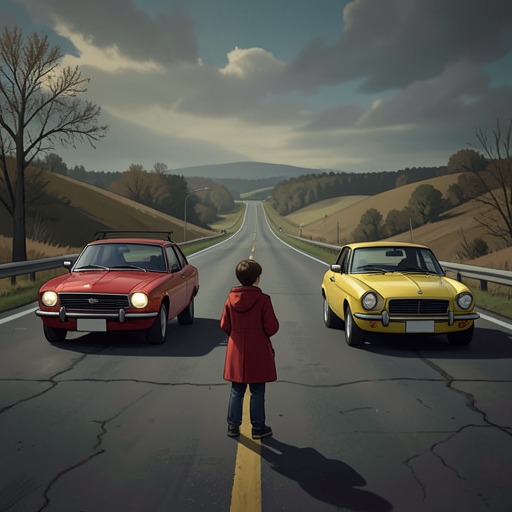
The Curious Incident of the Dog in the Night-TimeBlack Day is one of Christopher’s named day categories, triggered by seeing four yellow cars in a row. More than a label for bad luck, it is a rule-bound way of making an unpredictable day legible: the color sequence determines how Christopher manages his behavior, from not speaking to other people to seeking quiet and safety.
Definition and Rules
Christopher explains the system to Mr. Jeavons, the psychologist at Christopher’s school. Four red cars in a row make a Good Day, three red cars a Quite Good Day, and five red cars a Super Good Day; four yellow cars make a Black Day. On a Black Day, Christopher does not speak to anyone, sits by himself reading, does not eat lunch, and takes no risks. The categories are therefore not simply descriptions of mood: they prescribe distinct conduct.
Mr. Jeavons finds the system illogical, particularly because Christopher is otherwise evidently logical. Christopher distinguishes between logical order and other kinds of order. Numbers and arguments can be arranged logically, he says, but familiar patterns can also make things feel properly ordered. He compares the car-count system with office workers who let sunshine make them happy and rain make them sad, even when the weather has no bearing on their work. The comparison frames the Black Day rule not as a failed argument but as a personal structure for responding to the day.
Effects in Christopher’s Routine
The consequences become concrete when Christopher sees four yellow cars on the way to school on two consecutive days. On the first, he eats nothing at lunch and spends the day in a corner of the room reading his A-level mathematics course book. On the second, he again avoids speaking to anyone; throughout the afternoon he sits in the corner of the library, groaning with his head pressed into the join between two walls. The confined posture makes him feel calm and safe, showing how the category directs him toward a specific form of refuge.
After two Black Days in a row, Christopher is allowed to keep his eyes closed all the way to school until he gets off the bus. The exception is part of the system too: its rules do not merely classify days but provide procedures for handling a repeated difficult pattern. Reading, silence, withdrawal, and closed eyes reduce exposure to an environment that feels difficult to manage.
Order, Chance, and Narrative Function
The system draws a revealing contrast between random external events and dependable personal rules. A passing row of cars determines the day’s category, but Christopher’s response follows a consistent sequence. The same emphasis on routine appears in his description of Father: Father puts on his trousers before his socks and always climbs stairs two at a time, starting with his right foot. Christopher presents these habits as another way of liking things to be in a nice order, even when the order is not logical.
The categories also shape the pace of the narrative. After two consecutive Black Days, Christopher avoids looking at cars on the journey to school, temporarily stepping outside the system’s usual trigger. Five days later, five red cars in a row produce a Super Good Day, and he becomes certain that something special will happen. Nothing special occurs at school, so he expects it after school; at home, he goes to the shop to buy licorice laces and a Milky Bar with his pocket money. The shifting sequence—from repeated restriction to a bright category and heightened expectation—shows how the system gives ordinary observations a role in Christopher’s anticipation as well as his daily conduct.